 |
| Photo Credit: Nat Geo Explorers |
We've almost all heard about climate change; by now you hear the words "climate change" and you just shrug. There's nothing an individual can do and because of that, it isn't your problem, or the government needs to do something. These are all thoughts that may run through your head when you hear about climate change, but if you're thinking this... you're wrong.
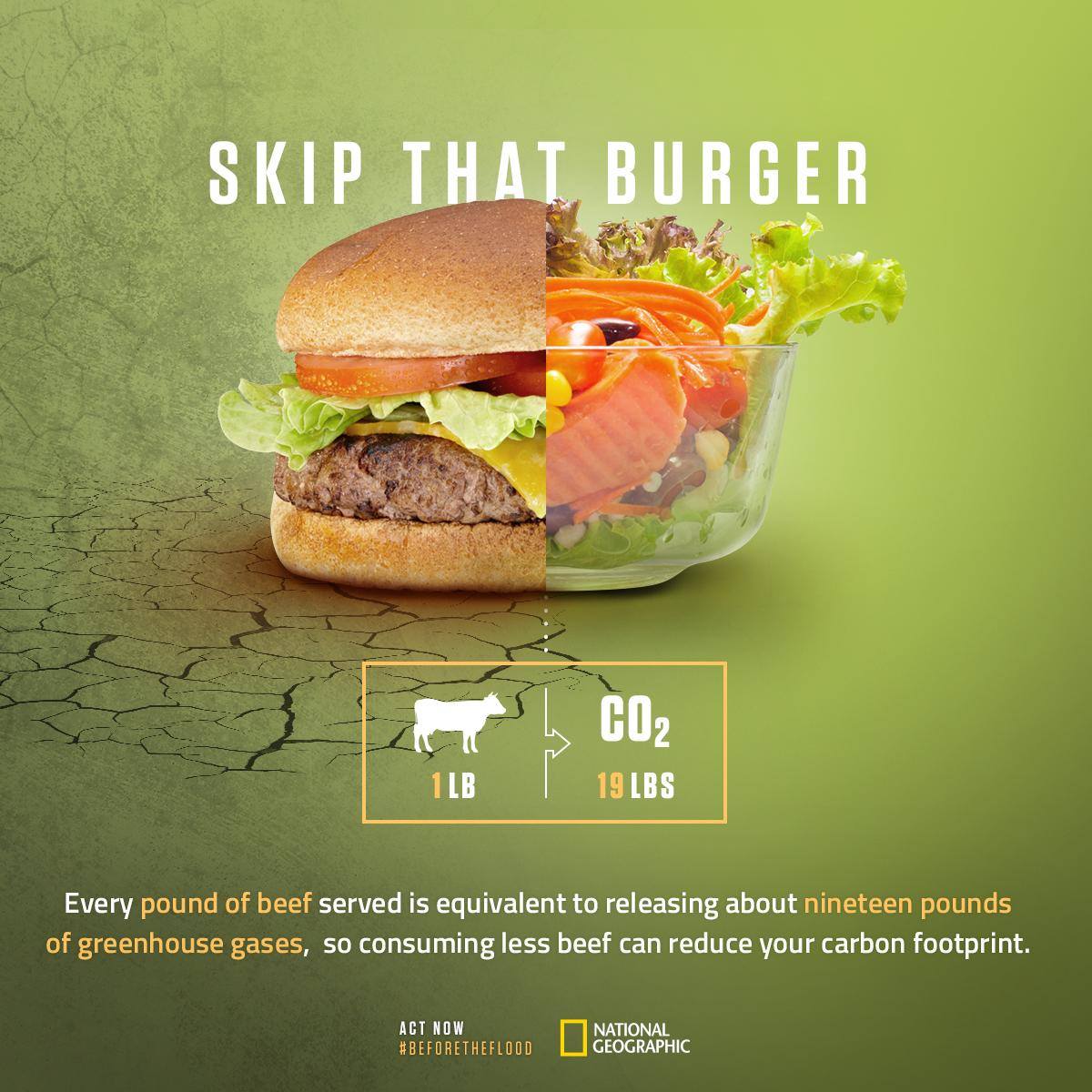
As an individual, there are many things you can do to reduce your carbon footprint. The government doesn't need to step in for people to take matters into their own hands. One big thing you can do as an individual is to eat less meat. I'm not saying to become a vegetarian or a vegan and ban meat altogether, just eat less of it.
In a study done by the Journal of Scientific Reports, "if everyone in the country reduced their consumption of beef, pork, and poultry by a quarter and substituted plant proteins, we’d save about 82 million metric tons of greenhouse gas emissions per year" (qtd in Mock and Schwartz). Not only would the cut back allow for a decrease in carbon emissions but it would also open up a lot of land (Mock and Schwartz). The new land would allow space for a variety of uses. Planting more trees is an option that would help with the control of greenhouse gases (Mock and Schwartz). Another idea presented in The Lancet, a British medical journal, is to use for the land is to produce more plant-based foods for our growing population (qtd in Gibbens).
 |
| Photo Credit: GivingCompass |
These two contributions may seem small but everything counts. By limiting your meat consumption you are taking a step to help climate change. By limiting your waste, you are taking a step in helping the natural world. You too can spread the news, tell your friends and family, together the difference only gets bigger and bigger. Let's take matters into our own hands and take the first step on the road to saving our planet.
Works Cited
Gibbons, Sarah. "Eating meat has 'dire' consequences for the planet, says report." National Geographic, 16 Jan. 2019, www.nationalgeographic.com/environment/2019/01/commission-report-great-food-transformation-plant-diet-climate-change/. Accessed 15 Nov. 2019.
Jacobo, Julia. "What you can do to help prevent climate change, according to experts." ABC News, 28 Sept. 2019, abcnews.go.com/US/prevent-climate-change-experts/story?id=65721423. Accessed 15 Nov. 2019.
Mock, Jillian, and John Schwartz. "Also this week, how an economic downturn could affect climate change." The New York Times, 29 Aug. 2019, www.nytimes.com/2019/08/21/climate/what-if-we-all-ate-a-bit-less-meat.html. Accessed 15 Nov. 2019.
Nat Geo Explorers. "If you're looking for just one thing to do to combat climate change, says @Enric_Sala, 'eat more vegetables and less meat.' #BeforetheFlood." Twitter, 27 Oct. 2016, 8:02 am, twitter.com/ NatGeoExplorers/status/791656372421201920.
"Seeing Is Believing: Using Technology To Highlight Climate Change Effects."givingcompass, givingcompass.org/article/flir-technology-new-technology-shines-a-camera-on-greenhouse gas-emissions/. Accessed 15 Nov. 2019.

Good overview and clear ideas, Bridget. your blog looks really nice. Are there any other practical things people can do?
ReplyDeleteOne thing you can do is get out and vote. By voting for a politician who sees climate change as a problem would have people in power joining the fight. Another thing you can do as an individual is drive a more fuel efficient car, or just drive less. This decreases daily CO2 emissions.
Delete